Marketing costs
Buying Leads vs Local SEO: A Contractor Cost Worksheet
Bought leads, ads or local SEO? A plain worksheet to compare cost per booked job, lead quality and capacity, so you know where your next marketing dollar goes.

TLDR
- Compare channels by cost per booked job, not cost per lead.
- Bought leads and ads are fast. Rankings take months, but they don't charge you per call.
- If your crew is already booked solid, buying more leads just buys more “no”s.
Every contractor gets the pitch. “We’ll send you leads.” Some of those leads turn into great jobs. Some turn into a voicemail, a tire kicker or a homeowner who already hired someone else.
The only way to know which channel is worth it is to do the math the same way for each one. Here’s a simple worksheet you can fill out in ten minutes.
Three ways to get the phone to ring
Most home service companies get calls from some mix of three places:
- Bought leads. Lead sites collect a homeowner’s request and sell it to contractors. Many sell the same request to more than one company, so you’re racing others to call first.
- Paid ads. Google Ads charge per click. Google’s Local Services Ads charge per lead. Both stop the moment you stop paying.
- Organic search. Your Google Business Profile and website show up in the map and search results. It takes months to build, and there’s no charge per call once it works.
None of these is always right. The point of the worksheet is to stop guessing.
Work out the cost per booked job
Cost per lead is the number the lead sellers like to quote. It’s the wrong number. A cheap lead that never books is the most expensive lead you’ll ever buy.
The number that matters is cost per booked job: what you spent on a channel, divided by the jobs it actually put on your calendar.
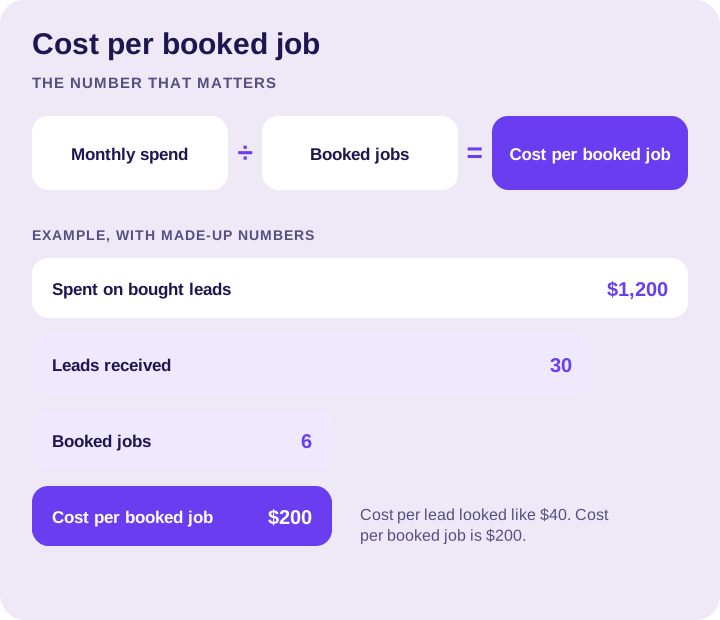
For each channel, write down:
- What you spent last month, including any monthly fees.
- How many leads it sent.
- How many became booked jobs.
- The average value of those jobs.
Then divide spend by booked jobs. Now you’re comparing apples to apples.
Count the time, not just the money
Chasing leads costs hours. If your office spends an hour a day calling back shared leads that already hired someone else, that’s part of the price. Put a rough number on it.
Organic calls tend to be different. Someone who found you on the map, read your reviews and called you is usually calling you, not five companies at once.
Check your capacity first
This is the part most marketing advice skips. If your crews are booked three weeks out, more leads don’t make you more money. They make you more “sorry, we can’t get to it.”
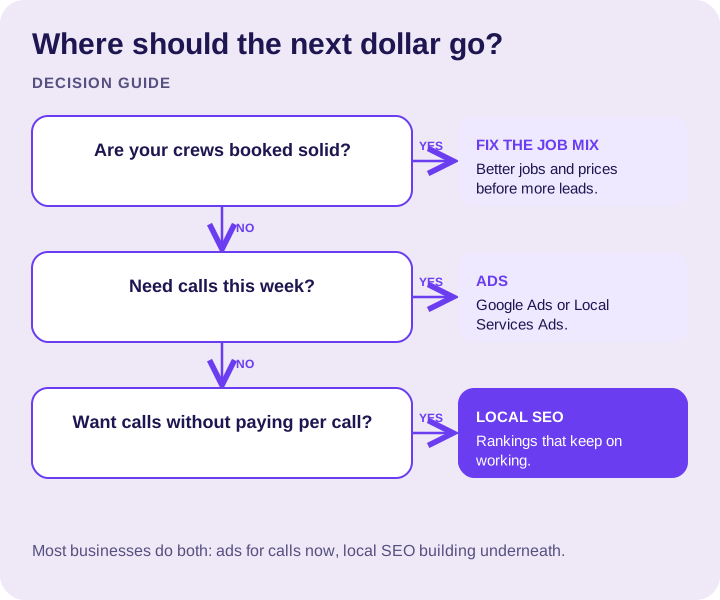
When you’re full, the smarter move is to go after better jobs, not more jobs: the service you make the most on, in the areas closest to your shop.
When each channel makes sense
- Use ads or Local Services Ads when you need calls soon, you’re entering a new area, or it’s peak season and you have open slots.
- Use bought leads carefully, if at all. Track them for a month and see what they really cost per booked job.
- Invest in local SEO when you want calls that don’t come with a per-lead bill, and you’re willing to give it a few months. Our Google Maps ranking checklist is where that starts.
Plenty of contractors run ads while their rankings build, then turn the ad budget down as organic calls pick up. That’s not a rule, it’s just common sense with a spreadsheet.
Track where every call comes from
None of this works if you don’t know where calls came from. A few simple habits help:
- Ask every new customer, “How did you find us?” and write it down.
- Check Calls in your Google Business Profile performance report. It counts taps on your call button. Give each ad campaign its own tracked number.
- Review the numbers once a month, not once a year.
Our paid advertising and local SEO reports both show calls by source, so you can see what each dollar did.
The bottom line
Cheap leads aren’t cheap if they don’t book. Do the math by booked job, check your capacity, and put your next dollar where it actually comes back.
Want help running the numbers on your current marketing? Let’s talk.
Want a hand with your profile?
Tell us about your business and the towns you serve. We can help you decide what to work on next.