Hiring help
What a Real Local SEO Report Should Show
Your marketing report looks great, so why isn't the phone ringing? What a real local SEO report should show, and six questions to ask your agency this week.

TLDR
- Impressions and visibility scores aren't jobs. Calls, messages and booked work are.
- A good report shows what was done, why, and what it brought in, including the bad news.
- Ask your agency six questions this week. How they answer tells you plenty.
It shows up around the first of the month. A clean PDF, your logo on the cover, a bunch of charts heading up and to the right. “Impressions up.” “Visibility score improved.” “Engagement trending positive.”
And your phone? Same as last month. Quiet.
To be fair, most of those reports aren’t lying. The numbers are probably real. The problem is what they leave out. A report built to keep you paying is a very different thing from a report built to tell you whether your marketing works.
The vanity metric shell game
Vanity metrics are numbers that look impressive and don’t connect to money. The usual suspects:
- Impressions. How many times your business appeared somewhere. Appearing isn’t the same as being chosen.
- Reach. How many people might have seen a post. Might have.
- “Visibility” or “authority” scores. Numbers made up by a software tool. Google doesn’t use them, and your customers have never heard of them.
- Keyword counts without context. “You rank for hundreds of keywords!” For what? Are those words anyone searches when they need to hire you?
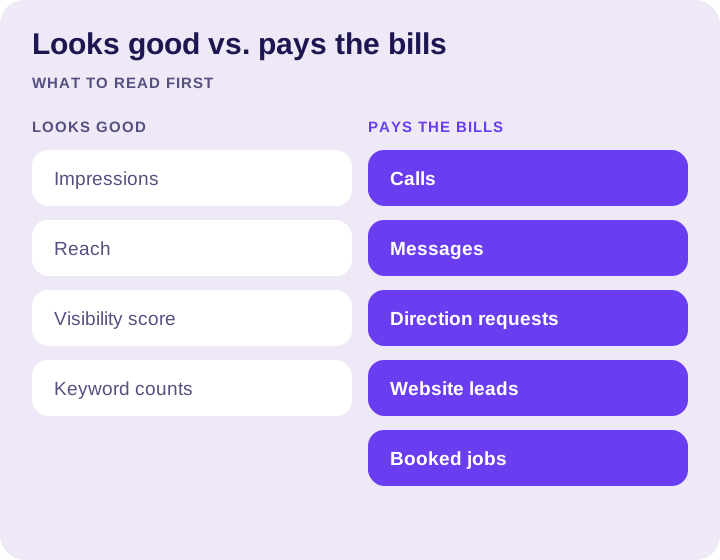
None of these are useless. They’re the warm-up. But when a report leads with them and never gets to calls, messages and booked jobs, ask why.
What a real report should show
When we built our reporting, we started with one question: what would a busy owner want to know in a few minutes? Here’s what belongs in a monthly local SEO report.
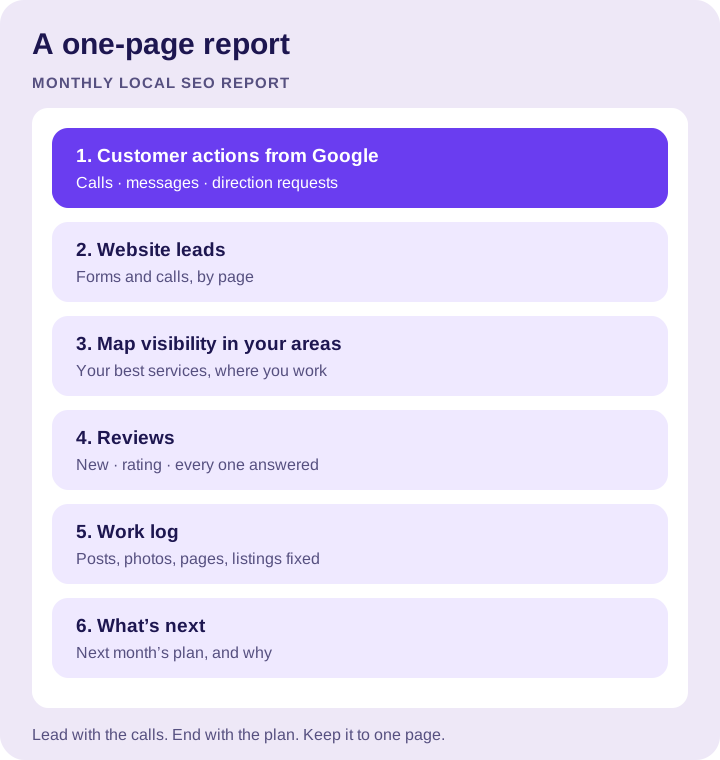
- Customer actions from Google. Calls, messages and direction requests from your Google Business Profile. These are people raising their hand. This number belongs at the top.
- Website leads. Form fills and calls from your website, and which pages produced them. If one service page brings in calls, you want more like it.
- Map visibility in your areas. Where you show up in Google Maps for the services that make you money, in the places you actually work.
- Reviews. New reviews this month, your rating, and whether every review got a reply.
- The work log. A plain list of what was done: posts published, photos added, pages built, listings fixed.
- What’s next. What’s planned for next month, and why.
That’s it. No glossary required.
What usually goes missing
- What was actually done. Not “optimized your online presence.” What changed on your profile, your website and your listings?
- Why it was done. Every task should tie to a reason: a service you want more of, an area you want to show up in.
- The bad news. If something dropped, you should hear it from your agency first, along with the plan to fix it.
If your report never has bad news in it, it’s not a report. It’s a brochure.
Six questions to ask your agency this week
You don’t need to be an SEO expert to hold an agency accountable. Ask:
- How many calls, messages and direction requests came from my Google profile last month?
- What specific changes did you make to my profile and my website?
- Which services and areas are you focused on, and why those?
- Can I log in and see my Google profile myself? Am I listed as an owner?
- What dropped this month, and what are you doing about it?
- If I wanted to leave, what’s the process?
A confident agency answers fast and in plain English. An agency that’s coasting reaches for jargon. Our agency checklist has more questions for when you’re shopping around.
“SEO takes time” is true, but it’s not a forever excuse
Local SEO isn’t instant. Anybody promising you the top spot by Friday is selling something you shouldn’t buy, and nobody can guarantee rankings.
But “it takes time” should come with evidence of motion: work being done, reviews coming in, profile activity growing, problems being explained. If month after month the answer is “be patient” and the report is all impressions, that’s not patience. That’s a subscription.
Why long contracts and vague reports go together
The vaguest reports often come attached to the longest contracts. When you can’t leave, the agency doesn’t have to prove anything. The report only has to be good enough to stop the questions.
We run the other way. Every plan is month to month, so our report has to earn the next month. Calls, messages and direction requests are in plain language at the top, good news or not. That’s how our local SEO and Google Business Profile management work.
The bottom line
A marketing report should answer three questions: What did you do? Why? What did it bring in? If yours can’t, the questions aren’t too hard.
Want a second set of eyes on the report you get now? Bring it to us. We’ll walk through it with you and tell you straight what the numbers mean, even if the answer is “your agency is doing fine.”
Want a hand with your profile?
Tell us about your business and the towns you serve. We can help you decide what to work on next.