Local SEO
Local SEO Competitor Analysis: A Home Service Checklist
A local competitor analysis checklist: find who really shows up on the map, compare profiles and websites side by side, and pick the three gaps to close first.

TLDR
- Your real competitors are the businesses on the map where your customers search, not the ones you see at the supply house.
- Compare profiles and websites line by line: category, reviews, photos, posts and service pages.
- Don't copy everything. Pick the three gaps that matter most and close them.
Most owners know who their competitors are. The trucks, the yard signs, the guy who keeps underbidding them. But the businesses you’re actually up against on Google are often different, and some of them you’ve never heard of.
A local competitor analysis finds out who really shows up when your customers search, and why. Here’s how to do one without paying for expensive software.
Step 1: Find who really shows up
Search the way your customers do, from where they are.
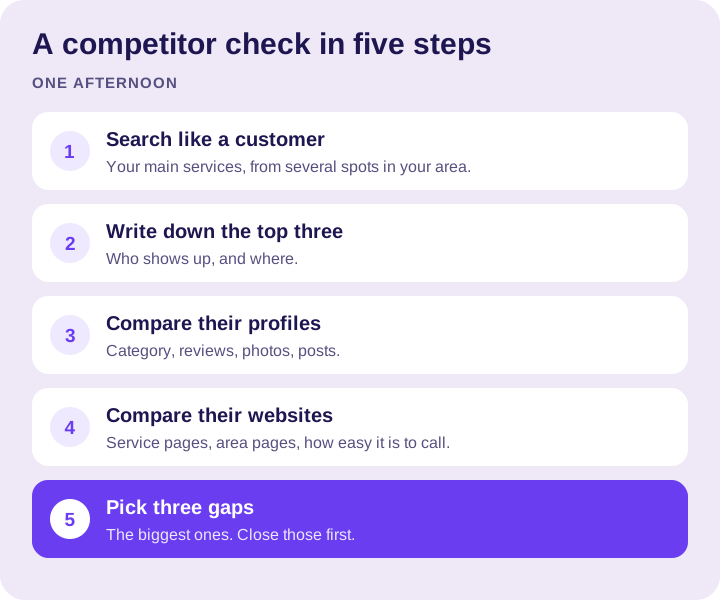
- Pick your three most valuable searches, like “roof repair near me” or “water heater replacement.”
- Search from several spots across your service area, not just your office. Results change with location, which is why the map looks different on the other side of town.
- Write down who shows up in the top three each time. The names that keep appearing are your real competitors.
Step 2: Compare their profiles
Open each competitor’s Google Business Profile and fill in a simple scorecard.
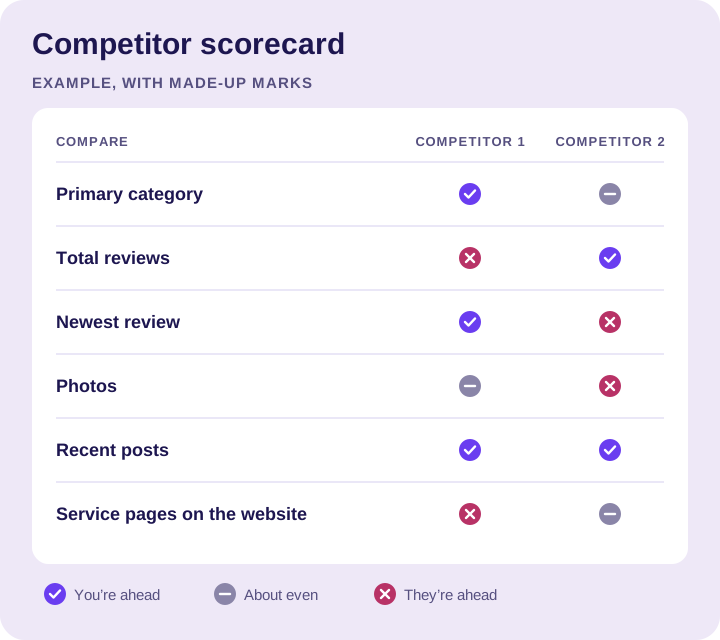
For each one, note:
- Primary category. It shows under the business name. If they’re more specific than you, that’s a clue.
- Reviews. How many, the rating, and how recent the newest one is. Steady new reviews matter more than an old pile.
- Review replies. Do they answer reviews? Do you?
- Photos. Real job photos, or a logo and nothing else?
- Posts and updates. Is anyone home?
- Hours and service area. Are theirs complete and yours not?
Step 3: Compare their websites
The profile is half the story. Click through to each competitor’s website:
- Do they have a page for each service you both offer?
- Do they have pages for the areas you both serve?
- Is the site fast on a phone, with a clear way to call?
- Does it answer common questions customers ask before hiring?
If they have a page for “sewer line replacement” and you don’t, Google has a clearer reason to show them for that search.
Step 4: Pick three gaps, not thirty
You’ll find a lot. Don’t try to fix it all at once. Pick the three gaps that are most likely to matter:
- Anything wrong with your category or services. It’s quick, and it affects every search.
- Missing service pages for your best-paying work.
- Review momentum, if theirs is steady and yours stalled months ago.
Fix those, then run the check again in a couple of months.
What not to copy
- Keyword-stuffed business names. Some competitors cram services into their name. It breaks Google’s guidelines, and it can get a profile suspended. You can report a misleading listing on Google Maps, but focus on your own profile first.
- Fake reviews. If a competitor’s reviews look bought, don’t follow them. It can sink your profile.
- Thin copy-paste area pages. A page per town with the same paragraph swapped around doesn’t help anyone.
How we measure it
When we do this for clients, we use a grid scan: the same search run from dozens of points across a service area, so you can see exactly where you rank and who beats you. The Everett case study shows what that looks like, including a leaderboard of the top five businesses in the scan.
You can also see how crowded your trade is in your state on our market map, and how many businesses compete per home in each state on our trade pages for plumbers, roofers and others.
The bottom line
Find out who really shows up, compare honestly, and close the three gaps that matter most. Then do it again.
Want us to run the scan for your business? Let’s talk. It’s how our local SEO work starts.
Want a hand with your profile?
Tell us about your business and the towns you serve. We can help you decide what to work on next.