Local SEO
Proximity vs Reviews: What Really Ranks You on Google Maps
How distance and reviews affect Google Maps rankings, why the closest business doesn't always win, and what a profile with zero reviews did about it.

TLDR
- Distance matters on Google Maps, but it's one of three things Google weighs, and you can't change it.
- Reviews feed prominence. They help, but they aren't the whole game.
- A bookkeeper with zero reviews ranked #1 of 59 in Everett. Relevance and a complete profile did the work.
Ask ten contractors why a competitor outranks them on Google Maps and you’ll hear two answers. “They’re closer.” And “They have more reviews.”
Both are partly true. Neither is the whole story. Here’s how distance and reviews actually fit together, and what you can do about each.
How Google decides who shows up
Google says local results are based mainly on three things: relevance, distance and prominence.
- Relevance: how well your profile matches what someone searched.
- Distance: how far you are from the person searching, or from the place they searched for.
- Prominence: how well known and trusted your business is. Google says review count and score are part of this.
No single factor wins on its own. Google blends them, which is why the closest business doesn’t always come first.
Why the map changes from block to block
Because distance is part of the mix, the map pack shifts depending on where the searcher stands. Search “plumber near me” in one neighborhood and you’ll see one top three. Drive ten minutes and search again, and the list changes.
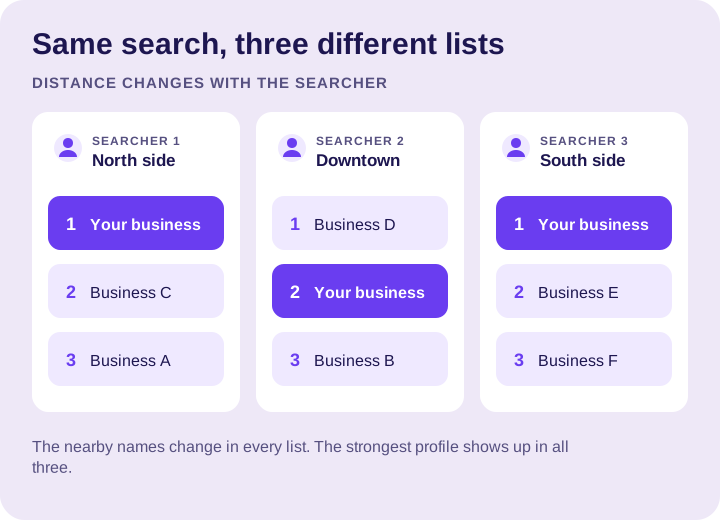
That’s why checking your ranking from your own office tells you almost nothing. It’s also why we scan a grid of locations when we measure a client, like the Everett case study did with 38 points.
What reviews actually do
Reviews matter in two ways.
For ranking, they’re part of prominence. More reviews and a better rating help Google trust your business.
For the customer, they’re often the deciding factor between the three businesses in the map pack. A profile with fresh, detailed reviews looks busy and trusted.
But reviews aren’t a cheat code. A business with hundreds of reviews and a vague profile can still lose to one that matches the search better.
Proof: zero reviews, #1 of 59
Foundation First Bookkeeping, a client in Everett, Washington, had zero Google reviews when we scanned “everett bookkeeping” from 38 points across a 5-mile radius. It still ranked #1 of all 59 businesses in the scan by average position, ahead of a competitor with 235 reviews.
Distance didn’t change. Reviews didn’t exist. What did the work was relevance and a complete, active profile: the right category, the right services and a website that backed them up. The full numbers are in the case study.
That’s one business in one market, not a promise. But it shows that reviews aren’t the only door in.
What you can control
You can’t move your shop. You can make Google more certain you’re the right answer, and more confident you’re trusted.
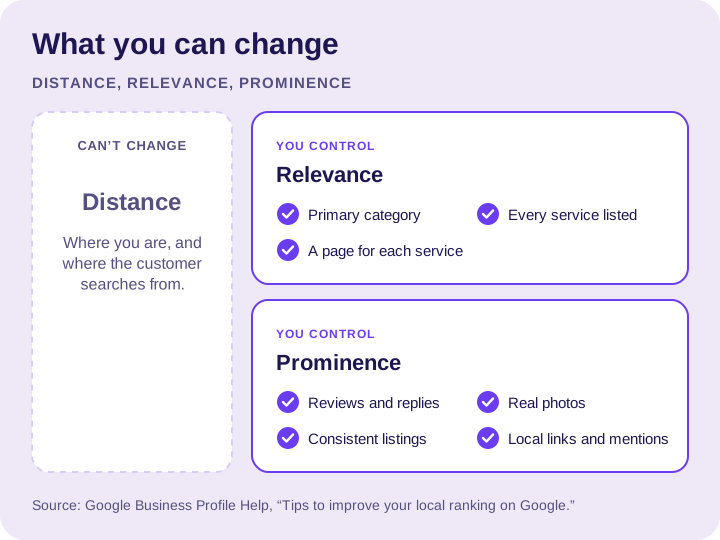
Relevance:
- The right primary category for the work that makes you the most money.
- Every service listed on your profile.
- A page on your website for each service and each area you serve.
Prominence:
- A steady routine for asking for reviews, and a reply to every one.
- Real photos added regularly.
- Consistent business listings across the web.
- Mentions and links from local organizations and sites.
How to compete with a closer business
If a competitor sits closer to most of your customers, you won’t beat them everywhere. But you can win in more places than you think:
- Match the search better. If they’re listed as a general contractor and you’re listed as a roofing contractor, you have the edge on roofing searches.
- Look more active. Fresh photos, posts and reviews make a profile look like the busier choice.
- Own your service pages. A page for each service gives Google a clear reason to show you for that search.
Our Google Maps ranking checklist puts all of this in order.
The bottom line
Distance is the one factor you can’t change. Reviews help, but they’re one part of prominence. The businesses that win more of the map are the ones that match the search best and look the most trusted.
Want to see where you actually show up across your area? Let’s talk. Our local SEO work starts with exactly that.
Want a hand with your profile?
Tell us about your business and the towns you serve. We can help you decide what to work on next.