Customer reviews
How to Respond to Negative Google Reviews (With Templates)
How to respond to negative Google reviews: when to reply and when to report, a simple reply formula, templates for common complaints and what never to do.

TLDR
- Reply to fair complaints, calmly and quickly. Report reviews that break Google's policies.
- Thank them, own what's yours, offer a way to fix it offline, and keep it short.
- Never argue, never share private details and never offer anything to get a review changed.
Every business that does enough work gets a bad review eventually. It stings, especially when you think it’s unfair. But the reply matters more than the review. Future customers read both, and a calm, professional answer can win you the next job.
Our review guide covers asking for reviews and replying in general. This one is for the hard ones.
First: reply or report?
Not every negative review should get the same treatment. Start by deciding which kind you’re dealing with.
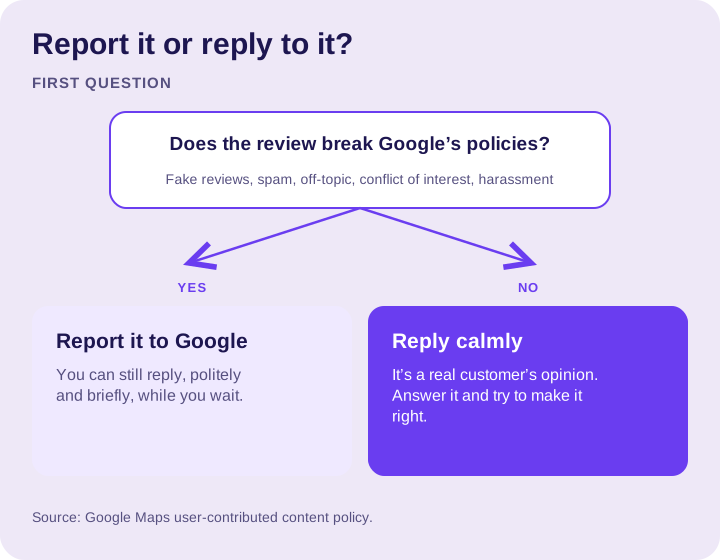
Report it if it breaks Google’s content policy: fake reviews, spam, reviews about a different business, conflicts of interest (like a competitor or ex-employee), harassment or hate speech. Google explains how to report inappropriate reviews from your profile. Google makes the final call.
Reply to it if it’s a real customer with a real complaint, even if you think they’re wrong. That review isn’t going anywhere, so make your answer count.
The reply formula
Most good replies to a negative review follow the same four steps.
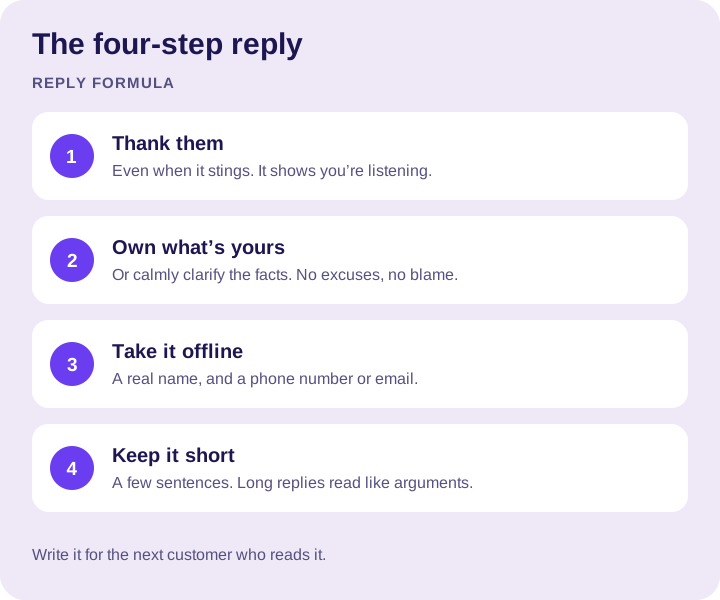
- Thank them. Even when it hurts. It shows you’re listening.
- Own what’s yours, or calmly clarify the facts. No excuses, no blame.
- Offer a way to fix it offline. A name and a phone number or email.
- Keep it short. A few sentences. Long replies read like arguments.
Templates for common complaints
Use these as starting points. Rewrite them for what actually happened.
Late arrival or a missed appointment:
Thanks for letting us know, and I’m sorry we were late. That’s not the standard we hold ourselves to. I’d like to hear what happened and make it right. Please call me directly at [number]. – [Name], owner
Unhappy with the price:
Thank you for the feedback. We give every customer a written price before we start, and I’m sorry if that wasn’t clear in your case. I’d be glad to walk through the invoice with you. You can reach me at [number]. – [Name]
Quality of the work:
Thanks for telling us. We stand behind our work, and we want to take a look. Please call our office at [number] so we can set up a time to come back out. – [Name]
A review you don’t recognize:
We take every review seriously, but we can’t find a record of this job under the details we have. If we worked with you, please call us at [number] so we can sort it out. – [Name]
If you believe a review like that is fake, report it as well as replying.
What never to do
- Don’t argue in public. Even if you’re right, you look defensive, and the next customer notices.
- Don’t share private details, like the customer’s address, invoice or job history. Google’s policy doesn’t allow personal information in reviews or replies.
- Don’t offer anything for a changed review. Refunds or discounts in exchange for editing or removing a review break Google’s rules.
- Don’t flood your profile with fake positive reviews to bury it. That can get your profile suspended.
- Don’t wait weeks. A quick reply shows you care. Aim for within a day or two.
After the reply
- Fix the real problem if there is one. If three reviews mention the same thing, that’s not bad luck.
- Follow up offline. If you make it right, the customer may update the review on their own. You can’t ask in exchange for something, but you can do the right thing.
- Keep asking happy customers for reviews. A steady flow of honest reviews puts one bad one in perspective.
The bottom line
A bad review isn’t the end of the world. A bad reply can be. Report what breaks the rules, answer the rest calmly, fix what you can and keep going.
If you’d rather hand off the replies, that’s our review management service, where we reply to every review and dispute the ones that break Google’s policies.
Want a hand with your profile?
Tell us about your business and the towns you serve. We can help you decide what to work on next.